


Quote

Aperture & Focus 2026: Week 19
May. 7, 2026
Aperture & Focus
Global Aperture
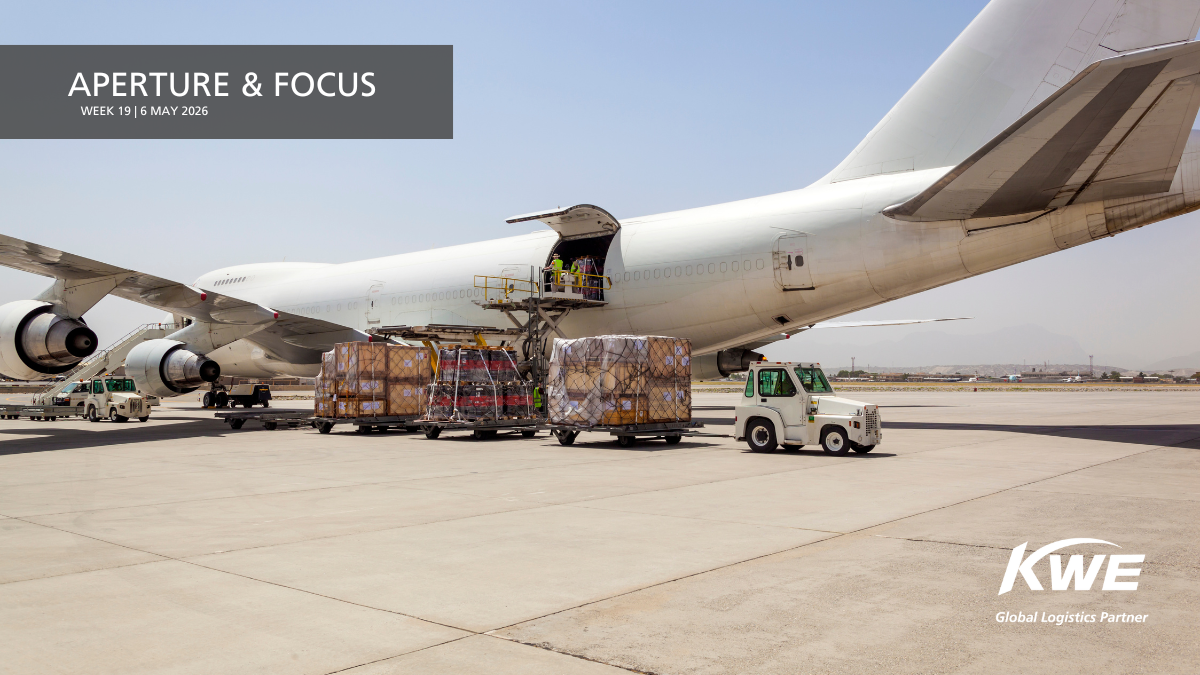
Iranian missile and drone attacks on the United Arab Emirates (UAE) on May 4 have triggered renewed airspace restrictions across the Middle East, reversing recovery momentum that followed the UAE’s reopening on May 2. The disruption has led to a global air cargo capacity shortfall with widespread closures and delays impacting key trade lanes, particularly between Asia and Europe.
Major air cargo carriers including United Cargo, Air Canada Cargo, and Cathay Cargo have implemented or adjusted fuel surcharges in response to rising jet fuel costs driven by Middle East conflict disruptions. These developments are contributing to reduced capacity growth, potential network adjustments, and ongoing pressure on transit times and reliability across global air freight operations.
Vessel traffic through the Strait of Hormuz remains near zero as ships continue to avoid the area, with at least 363 vessels clustering near Dubai amid Iran’s expanded control measures and renewed exchanges with the United States. Security incidents and warnings to vessels are increasing operational risk, prompting rerouting and delays across global supply chains, with no near-term timeline for a return to normal transit flows.
Regional Focus
Americas
United States: Rising diesel prices linked to the Iran conflict are tightening trucking capacity, as higher fuel costs and refinery disruptions reduce available supply across key regions. Additional strain from California refinery closures and strong industrial demand is limiting truck availability, particularly for fuel-intensive and specialized shipments, with capacity expected to remain constrained in the near term.
As of late April, U.S. trucking has also entered a driver shortage for the first time in four years, driven by regulatory changes and tightening labor availability. Reduced driver supply, combined with limited equipment replacement and upcoming regulatory pressures, is constraining trucking capacity and is expected to prolong tight conditions across the domestic freight market.
Asia-Pacific
China: E-commerce air export volumes from China declined by 6% year on year in March, marking the first annual drop since June 2023, according to a new report from market analytics firm Aevean. The decline was driven by reduced demand on key lanes to North America and the Middle East following U.S. policy changes affecting low-value shipments and disruptions linked to Middle East conflict developments in late March. While shipments to Europe and Latin America increased in March, they were not enough to offset sharp declines of 24% to North America and 45% to the Middle East and South Asia. Conditions are expected to improve in April as comparisons normalize and regional airspace disruptions begin to ease.
Bangladesh: A fire at the cargo terminal of Hazrat Shahjalal International Airport in Dhaka forced the suspension of all flight operations on May 2, with inbound aircraft diverted to alternate airports in Chattogram and Sylhet. The disruption temporarily halted cargo handling at the country’s primary air gateway, creating delays and potential backlogs as authorities worked to contain the incident and restore operations.
Europe, Middle East & Africa
Europe: On May 4, Mediterranean Shipping Company announced a new Europe–Red Sea–Middle East service connecting key European ports to Saudi Arabia and regional hubs, bypassing the Strait of Hormuz amid ongoing disruptions. The first vessel is scheduled to depart Antwerp on May 10, providing an alternative routing option for European exports as supply chains adjust to restricted access through the Gulf.
Middle East: Airspace across multiple Middle East countries remains fully or partially restricted, with major hubs in Dubai, Abu Dhabi, and Sharjah experiencing operational backlogs for time-sensitive cargo. Rerouted flights are extending transit times by 2–5 hours and reducing available payload capacity, creating ongoing pressure across global supply chains.