
Quote

Quote

  • ・Only enter lowercase letters or numbers.
  • ・For KWE Waybill, do not include hyphen.

You will be redirected after selecting a country/region.

CO<sub>2</sub>Calculator

Calculator

Close

Aperture & Focus

Aperture & Focus 2026: Week 4

Jan. 22, 2026
Aperture & Focus
Global Aperture

The European Parliament suspended approval of a U.S.–European Union trade agreement on January 21, 2026, following renewed political tensions after U.S. statements regarding Greenland raised concerns about a return to confrontational trade measures. While U.S. officials later signaled a pause on new tariff actions, the delay introduces near-term uncertainty for transatlantic trade planning until parliamentary approval efforts resume.

 Major container lines are gradually returning ships to the Red Sea and Suez Canal as security conditions improve, marking a step toward normalization of East–West trade routes after more than two years of diversions. During the first half of its fiscal year (July 1, 2025 through December 31, 2025), Suez Canal traffic increased 5.8 percent year over year, while A.P. Moller-Maersk announced that it had redirected a regular service through the canal. However, routing decisions remain fluid, with CMA CGM announcing on January 20, 2026 that it would reroute several services back around the Cape of Good Hope, underscoring that carriers continue to adjust plans based on evolving regional conditions.

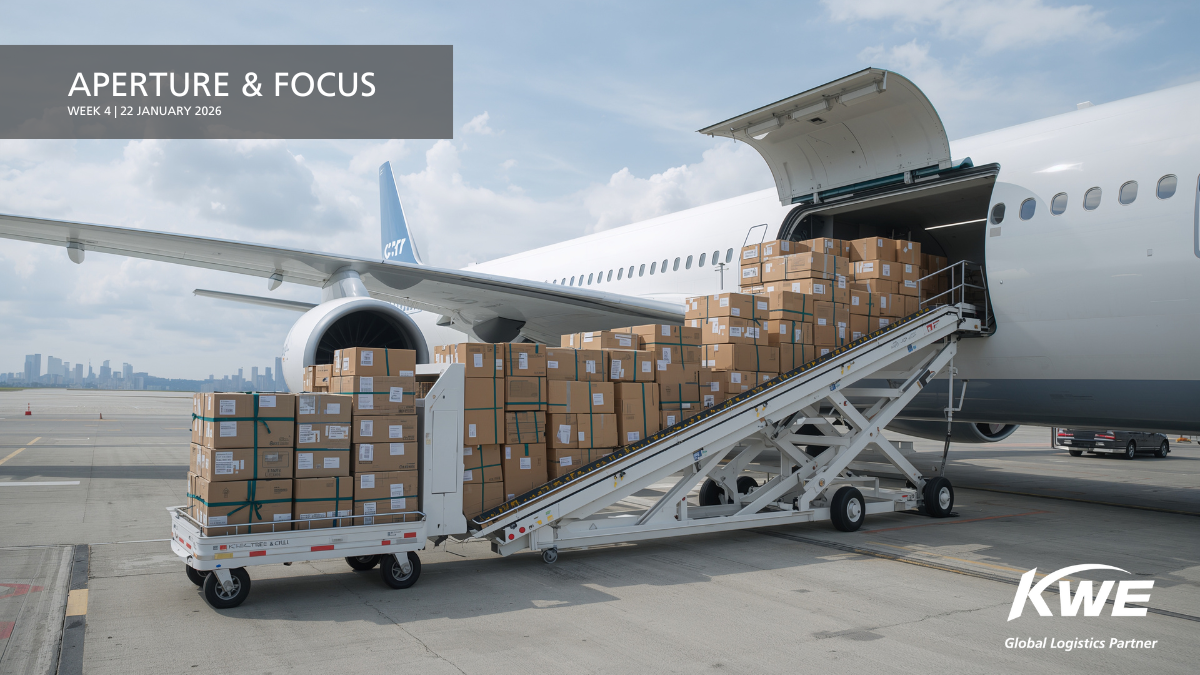
 Global air cargo began 2026 with strong momentum according to market analytics firm World ACD, as volumes in the first full week ending January 11th, 2026 rose 5% year over year, led by Middle East & South Asia (+16%), Asia Pacific (+8%), and North America (+7%), though growth is amplified by a slow start to 2025. Despite the rebound, the market outlook remains uncertain as freighter capacity continues to return and the gradual resumption of container shipping via the Red Sea/Suez Canal could pressure air cargo demand later in the year.


Regional Focus

Americas

United States: Countries included in U.S. President Trump’s proposed tariff measures linked to the Greenland dispute account for nearly 60% of westbound air cargo to the U.S., totaling 685,000 metric tons between May–October, led by Germany, followed by the United Kingdom and France. Air cargo volumes from these markets have remained resilient despite earlier tariffs; though the impact of a new round effective February 1st remains uncertain, prompting calls for a measured approach to protect supply chains.

 U.S. trucking conditions remain tighter than typical for January, with tender rejection rates near 10% indicating sustained capacity constraints and limited slack in shipper routing guides, according to recent market data. While import activity remains relatively muted and rail continues to capture a share of long-haul freight, contracting inventories and resilient consumer demand could increase urgency in shipper networks later in 2026, supporting continued tightness if volumes accelerate.


Asia-Pacific

China & Hong Kong: The Port of Shanghai maintained its position as the world’s busiest container port for the 16th consecutive year, recording its busiest year on record with more than 55 million TEU handled in 2025. The milestone was driven by growth in international transshipment activity, deep-water terminal volumes, and expanded sea-rail connectivity, reinforcing Shanghai’s role as a critical hub for global and Asia-focused supply chains.

Despite ongoing trade tensions with the U.S., cargo momentum has remained strong, with Hong Kong International Airport also reporting continued air cargo growth, including a 3.6 percent year-on-year increase in December 2025 and full-year throughput of 5.1 million metric tons, supported by export and transshipment flows.


Europe, Middle East & Africa

European airlines continued to avoid Iraqi and Iranian airspace on January 15th despite Iran reopening its skies, opting for longer alternative routes due to ongoing geopolitical tensions in the Middle East. The diversions are increasing flight times and operational complexity, highlighting persistent security risks that continue to disrupt aviation activity across the region.

 United Kingdom: London Gateway recorded strong container growth in 2025 and is now positioned to become the UK’s largest container port, supported by expanded berth capacity, new Asia–Europe vessel calls, and the opening of a second on-dock rail terminal. Further terminal expansions and automation investments announced in January 2026 are expected to enhance throughput, inland connectivity, and resilience for UK import and export supply chains.

Belgium: A farmers’ protest has disrupted cargo operations at Brussels Airport, with access to the Brucargo logistics zone intermittently blocked by tractors since January 15, and the action set to continue until at least Saturday, January 17, 2026. While priority medical shipments are being allowed through, the blockade has caused delays to cargo flights and trucking movements, creating congestion and potential knock-on effects for time-sensitive air freight

Back to Top

When you visit any website, it may store or retrieve information on your browser, mostly in the form of cookies. This information might be about you, your preferences or your device and is mostly used to make the site work as you expect it to. The information does not usually directly identify you. Because we respect your right to privacy, you can choose not to allow some types of cookies. Click on the Cookie Setting to set. Please note that some cookies are necessary for the proper functioning of the website and cannot be disabled on our system.

  • These cookies are necessary for the website to function and cannot be switched off in our systems.