


Quote

Aperture & Focus 2026: Week 30
Jul. 22, 2026
Aperture & Focus
Global Aperture
The collapse of the United States-Iran ceasefire has renewed security risks in the Strait of Hormuz, with commercial vessel traffic remaining well below normal as shipowners continue to avoid the region despite the waterway remaining open. Industry organizations warn that threats from drones, mines, electronic interference, and congestion continue to disrupt operations, creating ongoing uncertainty for global energy and supply chain flows.
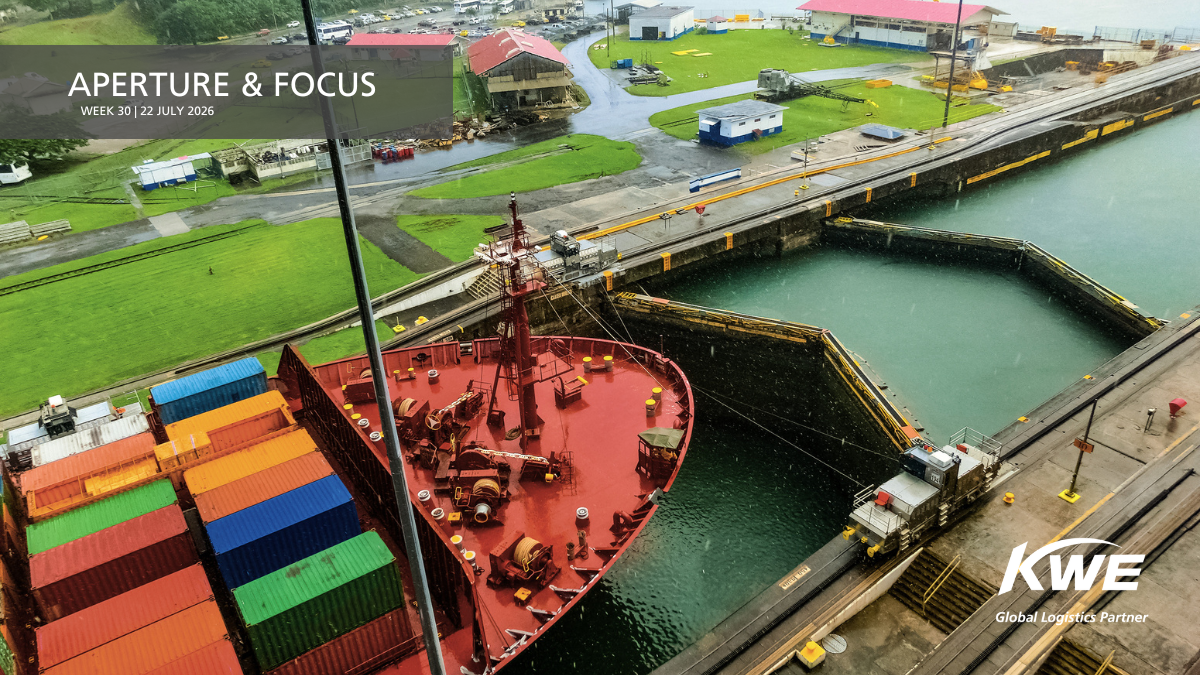
The Panama Canal Authority will temporarily reduce booking availability beginning July 25 due to declining water levels and the growing risk of El Niño, limiting daily transit capacity for Panamax vessels. The move adds pressure to global supply chains already affected by disruptions in the Strait of Hormuz and Red Sea, with shippers potentially facing greater competition for transit slots and longer planning timelines.
Air cargo volumes from Asia Pacific to Europe fell 15% year over year during the week of July 6–12, driven by lower shipments from China and Hong Kong following the European Union’s July 1 changes to low-value import rules. Typhoon Bavi also disrupted operations across parts of East Asia, reducing capacity and cargo volumes from Taiwan and, to a lesser extent, China and neighboring markets.
Regional Focus
Americas
United States/Canada: U.S. President Donald Trump announced an additional 50% tariff on hundreds of Canadian products, scheduled to take effect on August 19, while leaving a 30-day window for negotiations or policy changes. Products already subject to Section 232 duties, including automobiles, steel, aluminum, copper, semiconductors, and qualifying civil aircraft, remain exempt, though the new measures could affect a broad range of agricultural, industrial, and consumer goods moving across the U.S.-Canada supply chain.
Asia-Pacific
China: Congestion continues at major Chinese ports following disruptions caused by Typhoon Bavi, with Shanghai and Ningbo experiencing vessel backlogs and shipment delays of up to five days despite resumed operations. Industry stakeholders expect recovery to take several weeks as vessel bunching, berth congestion, rolled bookings, and equipment imbalances continue to affect export supply chains.
Hong Kong: Hong Kong International Airport handled 5.1 million metric tons of cargo during fiscal year 2025/26, a 2.7% increase year over year, maintaining its position as the world's busiest cargo airport for the 15th time since 2010. The airport also expanded its global network, advanced new cargo handling capabilities through the Hong Kong International Airport Dongguan Logistics Park, and continued investing in cross-border logistics infrastructure to strengthen connectivity with southern China.
Europe, Middle East & Africa
Europe: Water levels on the Danube River in Romania fell to their lowest point in nearly 30 years, disrupting barge traffic, suspending some ferry services, and slowing grain shipments from one of the European Union’s largest agricultural exporters. Authorities have also restricted irrigation in parts of southeastern Romania, though river levels are expected to improve gradually following recent rainfall.
Poland: Poland is positioning its planned Central Transport Hub as a major European air cargo gateway, aiming to expand long-term cargo capacity while avoiding heavy reliance on Chinese e-commerce traffic. The new airport, designed to relieve capacity constraints at Warsaw Chopin Airport, is expected to increase annual cargo handling from approximately 146,000 to 450,000 metric tons and strengthen Poland's role as a logistics hub connecting Eastern and Western Europe.