


Quote

Aperture & Focus 2026: Week 35
Aug. 27, 2026
Aperture & Focus
Global Aperture
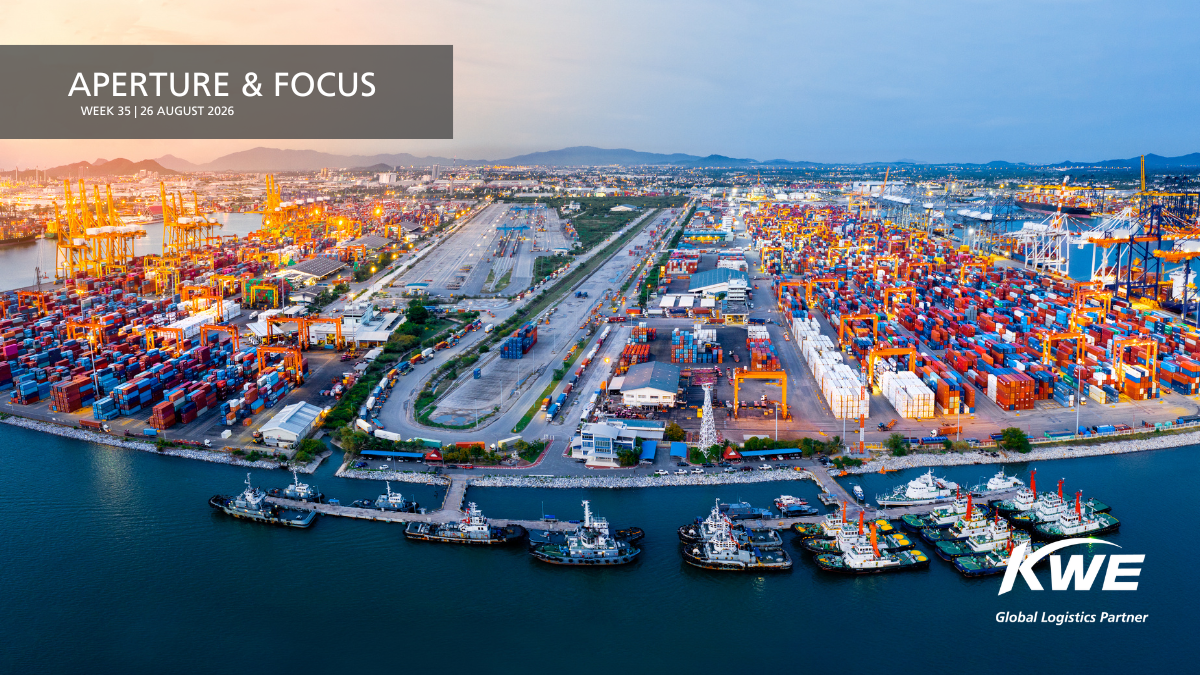
Port delays and congestion are currently tying up about 5% of global deep-sea container capacity, equivalent to roughly 1.7 million twenty-foot equivalent units (TEUs), as vessels face longer delays than before the pandemic. Congestion remains particularly acute in Asia, Northern Europe and the Middle East, with Shanghai, Singapore, Hong Kong, Rotterdam, Antwerp and Hamburg among the affected gateways.
Congestion at the Panama Canal is worsening as increased vessel demand, including ships avoiding Middle East gateways, pushes waiting times for container vessels to as long as 10 days. At the same time, below-expected rainfall is putting renewed pressure on water supplies, prompting the Panama Canal Authority to reduce daily transit capacity beginning September 3, with Neopanamax transits limited to nine per day and Panamax transits to 25, while planned draught reductions have been postponed to September 2 and October 1.
Global air cargo volumes fell 5% week over week from August 10-16, extending declines across most origin regions as available capacity contracted for the second consecutive week. Asia Pacific shipments to Europe continued to diverge from stronger U.S.-bound demand, with volumes to Europe down 14% year over year as reduced e-commerce flows following the European Union’s removal of its de minimis exemption continued to weigh on the trade lane.
Regional Focus
Americas
United States: Intermodal freight volumes continue to grow as tight truckload capacity pushes more shippers toward rail, with domestic container traffic up 7.4% in the first half of 2026. While localized congestion and chassis shortages are affecting some terminals, the network remains fluid overall, though shippers are advised to build extra time into supply chains ahead of the September peak season.
Canada: Canada will impose new tariffs of 15% to 50% on about 700 U.S. products beginning September 8, including steel, aluminum, plastics, appliances, agricultural equipment and electronics, in response to new U.S. tariffs on Canadian goods. The measures could affect cross-border supply chains in industries ranging from manufacturing and agriculture to consumer goods, adding further uncertainty to trade between the two countries.
Asia-Pacific
Japan: Japan’s exports rose 23.2% year over year in July to a record high, driven by strong semiconductor and artificial intelligence-related demand, including shipments to the United States and China. Imports also reached a record as higher energy costs and increased crude oil volumes from alternative suppliers pushed up the value of inbound goods.
Europe, Middle East & Africa
Recent rainfall has raised Rhine water levels significantly, allowing vessels to carry more freight after record-low conditions earlier in August severely restricted navigation. Shallow water still limits vessel loads, while some freight continues to shift to land transport, keeping pressure on logistics operations along the river.
Saudi Arabia: Congestion at alternative Middle East gateways is worsening as Khor Fakkan, Fujairah and Sohar face vessel berthing delays of up to 14 days amid shifting regional cargo flows. Landside capacity is also struggling to keep pace, with limited trucks and other assets available to evacuate containers and support cross-border movement, adding to supply chain bottlenecks.
Norway: Norway will begin phasing in its mandatory Digitoll digital customs system on September 15, requiring customs information to be submitted before goods reach the border. Low adoption among air, sea and rail shipments has raised concerns about delays, while full enforcement across all transport modes is scheduled for March 1, 2027.
South Africa: Congestion at Durban’s Gateway Terminal has worsened, with delays reaching 10 days and some carriers warning customers of waits of up to 20 days as Pier 2 remains heavily constrained. The backlog is being compounded by vessel diversions around the Cape from the Red Sea, while new terminal systems and workforce retraining are adding to operational delays.
Severe congestion at Durban Gateway Terminal is causing delays of up to a week as the port struggles with equipment breakdowns and operational problems following the transition to a new container management system. Productivity has fallen to less than one-third of normal levels, prompting the South African government to intervene as of August 21 as industry groups warn of growing disruptions across national supply chains.