


Quote

Aperture & Focus 2026: Week 43
Oct. 21, 2026
Aperture & Focus
Global Aperture
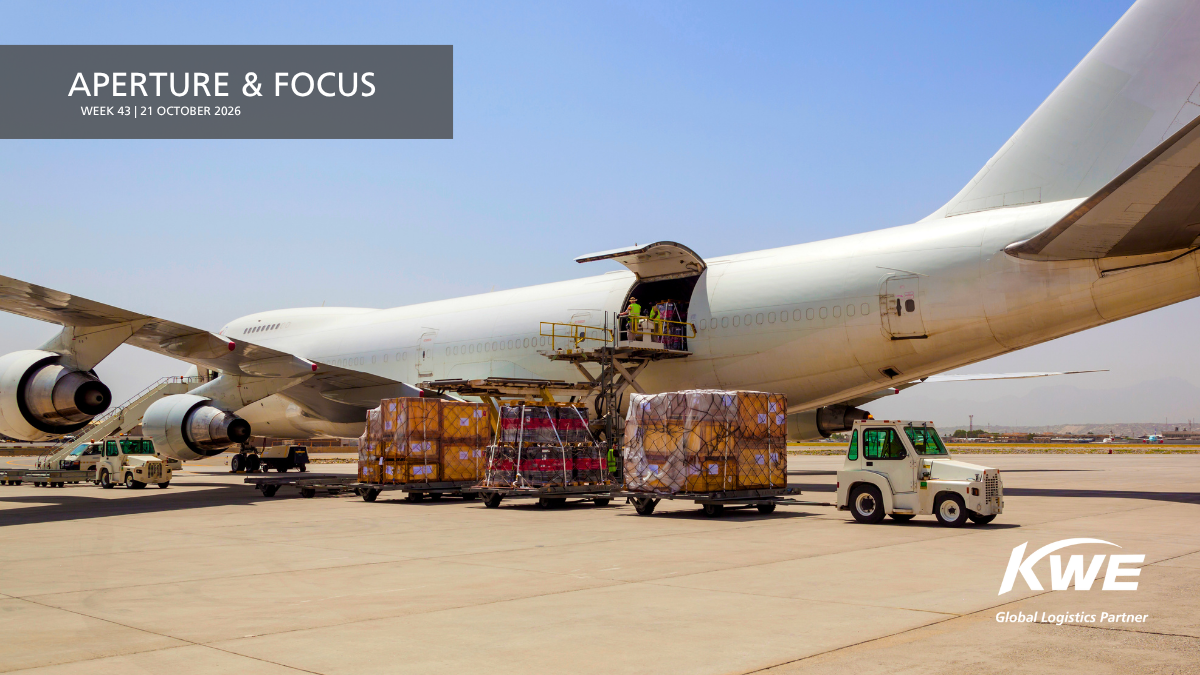
Global air cargo tonnage rebounded in September after declining in August, with year-over-year growth across all major origin regions, according to WorldACD Market Data. However, China-to-Europe volumes remained below year-ago levels following the European Union’s removal of its low-value goods exemption in July, while China-to-U.S. volumes continued to grow.
Approximately 63% of container capacity deployed between the Far East and Europe has returned to the Red Sea and Suez Canal following three years of diversions, according to maritime research firm Alphaliner. However, some carriers are maintaining Cape of Good Hope routes as a precaution against renewed disruption, creating a mix of routing options across major trade lanes.
The Panama Canal handled a record 521 million tons of cargo in fiscal year 2026, up 6.5% from the previous year, as energy shipments, container traffic, and shifts in global trade routes boosted demand. The Panama Canal Authority also reported a 4.1% increase in vessel transits to 13,951 and is restoring its Last-Minute Reservation service for vessels using the Panamax locks following improved rainfall and water levels.
Regional Focus
Americas
United States: U.S. Customs and Border Protection (CBP) has tightened filing requirements for imports valued at $2,500 or less, requiring electronic submissions upon or before arrival and additional shipment data. The compliance deadline for new postal entry requirements has been delayed from October 22, 2026, to January 20, 2027, giving importers, customs brokers, and logistics providers more time to update systems and processes.
The trucking market continues to face tightening capacity and rising shipment rejections despite weak freight demand, increasing the risk of delays and more difficult load coverage for shippers. Industry analysts attribute the pressure to driver restrictions, rising operating costs, and carriers exiting the market, while some experts recommend consolidating shipments to improve equipment utilization and reduce overall logistics costs.
Mexico: The United States lifted flight restrictions on Mexican airlines effective October 16, 2026, following disputes over airport slot allocations and Mexico’s requirement that U.S. cargo airlines relocate operations away from Mexico City’s Benito Juárez International Airport. The restrictions stemmed from U.S. concerns over compliance with the 2015 bilateral air transport agreement; their removal allows Mexican airlines to add new U.S. routes from both Mexico City airports, subject to remaining filing and approval requirements.
Asia-Pacific
Sri Lanka: Colombo’s West International Terminal has launched its second phase, doubling annual capacity to 3.2 million twenty-foot equivalent units (TEU) to support growing transshipment demand. Meanwhile, the Sri Lanka Ports Authority is expected to seek new bids for South Asia Gateway Terminals when its 30-year concession expires in 2029, potentially reshaping terminal operations at a key hub on the Asia-Europe trade route.
Hong Kong: Air cargo volumes at Hong Kong International Airport saw 6.3% year-over-year growth in September after two consecutive months of declines, according to the Airport Authority of Hong Kong. The rebound was driven by stronger transshipments and imports, particularly from Southeast Asia and mainland China, offsetting continued weakness in shipments to Europe following the European Union’s removal of its duty-free exemption for low-value parcels in July.
China: The Port of Shanghai set a new monthly container-handling record in September, recovering from disruptions caused by three typhoons since July. The Shanghai International Port Group reported that operations have returned to normal after efforts to clear backlogs and coordinate vessel arrivals, although a significant number of ships remained at anchor as of October 10.
Europe, Middle East & Africa
Unseasonably low water levels on the Rhine are restricting container barge capacity, forcing cargo onto already-constrained rail and road networks and increasing transit times and delays. The disruption is particularly severe in southern Germany and the Upper Rhine corridor, with rail capacity reportedly booked weeks in advance and truck shortages complicating inland cargo movements, although the Port of Rotterdam says its operations remain normal.
European Union: New parcel handling fees expected from November 1, alongside customs duties introduced in July, could make bulk imports for local fulfillment more attractive to retailers, according to Dutch advisory firm Holdwise. The development comes as China-Europe airfreight capacity remains below year-ago levels, adding pressure to cross-border supply chains.